


Director: Denis Villeneuve
Cast: Timothee Chalamet, Zendaya, Rebecca Ferguson, Josh Brolin, Austin Butler, Florence Pugh, Dave Bautista, Christopher Walken, Lea Seydoux, Souhelia Yacoub, Stellan Skarsgard, Charlotte Rampling, Javier Bardem
Screenplay: Denis Villeneuve, Jon Spaihts
166 mins. Rated PG-13 for sequences of strong violence, some suggestive material and brief strong language.
There’s a shot in the first five minutes of Dune: Part Two that features the burning of Atreides garb, echoing a similar shot from the first film, a dream or vision of Paul Atreides (Timothee Chalamet, Interstellar). Seeing something as simple as the fulfillment of our lead’s vision in such tragic display as the ruination of his family and people caused the hair on my arm to stand up, and that feeling of goosebumps lasted for the next three hours.

Picking up immediately following the events of the 2021 film, Paul and his mother Lady Jessica (Rebecca Ferguson, Mission: Impossible – Dead Reckoning) have joined the Fremen and are taken under the protection of Stilgar (Javier Bardem, mother!). Paul takes every opportunity to ingratiate himself within the Fremen lifestyle, while Jessica embraces the very prophecy her people helped to propagate. As the Fremen continue their attacks on the Harkonnen spice-mining process, Baron Vladimir Harkonnen (Stellan Skarsgard, Good Will Hunting) turns to his psychopathic nephew Feyd-Rautha (Austin Butler, Once Upon a Time in Hollywood) to bring his special set of skills to remove and shatter the Fremen people once and for all.
There have already been a number of extremely positive reactions all over social media concerning Dune: Part Two, and I can only continue to echo my love for this follow-up. My issue with the first film was always about the way in which director Denis Villeneuve (Blade Runner 2049) elected to end his film, creating what I believed to be a Part One problem (a film I wouldn’t want to watch again without a follow-up), but as soon as I knew he’d be able to complete his vision of Frank Herbert’s novel brought me a sense of relief. To put it simply, I have had faith in Villeneuve since the double-punch of Prisoners and Sicario, where I first became aware of him. Here, Villeneuve is able to pay off every piece of set up and world-building he began with his first film while providing some new visual flourishes and some truly powerful and cheer-worthy moments of action and climax.

Timothee Chalamet’s performance as the young Duke without a home, finding himself further entrenched in the stranger in a strange land of Arrakis, is something I hadn’t quite seen from the excellent young performer. Here, Paul embraces his new environment in an effort to survive, beginning with the appearance of a lost puppy attempting to feign bravery and elevating to the hero he is believed to be. This is a greater turn for our protagonist, adding the knowledge of his perceived visions and future to his ability (or inability) to change his fate and his concern over these choices which may not be entirely under his control.
Zendaya (Spider-Man: No Way Home) also has way more to do this time around after her minimal introduction in the first film as Chani, a member of the Fremen who Paul is drawn toward after dreaming about her prior to their meeting. Chani’s character is the one we are best able to view Paul through as he undertakes several transformations and reinventions in the narrative. She is our access point for the Fremen, and she and Chalamet have terrific chemistry.

It was surprising for me to find a solid amount of the film’s more comedic moments (that’s not to say it’s riddled with LaughOutLoud hijinks by any means) come from Bardem’s Stilgar, another character with a pretty small amount of screen time the first go around. His is an archetype character who believes there is more to the prophecies than lies, similar to Qui-Gonn Jinn or Morpheus, two characters who likely got inspiration from Stilgar’s character in the novel, and it is only in the moments of liveliness that Bardem’s performance is able to sidestep a number of the comparisons that could be made.
Dune: Part Two also introduces a number of new characters, including Austin Butler, who continues his chameleonic series of performances as the psychopathic nephew of the Baron (starkly distancing himself from Sting’s version of the character in Lynch’s adaptation), and also Florence Pugh (Midsommar) as the Princess Irulan Corrino, daughter of Emperor Shaddam (Christopher Walken, Pulp Fiction). Pugh and Walken share some of the most interesting scenes of dialogue in how they, like a tennis match, comment back and forth on the struggle for order on Arrakis. Pugh’s questioning of her father’s decision-making plays nicely with Walken’s stoicism.

From a technical standpoint, Oppenheimer and others should be thankful they won’t have to compete at this year’s Academy Awards. For everything that the first Dune accomplished, Part Two adds and builds upon what worked. Greig Fraser’s cinematography is lush and gorgeous, capturing the dry and arrid Arrakis and also introducing the Harkonnen world of Geidi Prime with its unusual outdoor color scheme due to its unique sun, casting a shadowy shades-of-gray aesthetic to the planet, punctuated by ink blot fireworks (furthering the importance of deals and inked contracts to the politics of the Imperium).
Hans Zimmer also adds a few upgrades to his score, continuing and evolving upon the themes introduced in the first film, highlighting the more emotionally devastating journey that Paul finds himself on this time around.

I won’t consider myself an extremely knowledgeable Dune diehard (I’ve read the initial novel and seen Lynch’s film prior to Villeneuve’s take), but Dune and its sequel have done what many considered to be near-impossible by adapting a book considered by many as unadaptable. I could tell this was Villeneuve’s Star Wars growing up, the story he’s been leading to his entire career. His adaptation with co-screenwriter Jon Spaihts expertly changes what is necessary in order to the make the story palatable for the language of cinema, even though it does cut a few characters and change a few story beats in doing so (and I still don’t know where Tim Blake Nelson is in the finished film). None of the changes made with this screenplay take away from the impact of the story in any real way.
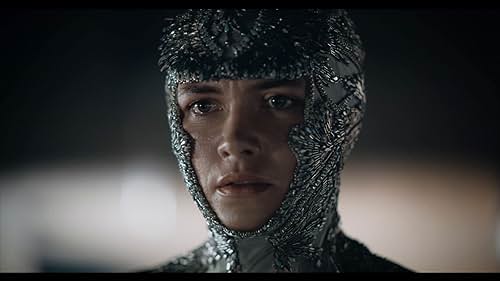
Dune: Part Two is a triumph for Denis Villeneuve and everyone involved. Not since Peter Jackson tackled The Lord of the Rings has a genre series had the level of care and attention given that it re-contextualizes how fantasy and sci-fi will look for years to come. It’s an excellent experience full of all the payoff necessary to elevate its predecessor and become a perfect complete story, one that I’ll be thankful to watch for decades to come. While it likely won’t win over moviegoers who didn’t like the previous installment, Dune: Part Two comes with my highest recommendation. I loved this movie.
5/5
-Kyle A. Goethe
For my review of Denis Villeneuve’s Dune, click here.
For my review of Denis Villeneuve’s Arrival, click here.
![[Early Review] The Bikeriders (2023) – GOAT Film Reviews Avatar](https://goatfilmreviews.com/wp-content/uploads/2024/10/cropped-screenshot_20241014_173224_gallery-1.jpg?w=48)
![[Early Review] You, Me & Tuscany (2026)](https://goatfilmreviews.com/wp-content/uploads/2026/04/you_me__tuscany55702908462263236109722.jpg?w=1024)
![[Early Review] The Super Mario Galaxy Movie (2026)](https://goatfilmreviews.com/wp-content/uploads/2026/04/images2828296158163771698169022.jpg?w=398)
![[Early Review] Ready or Not 2: Here I Come (2026)](https://goatfilmreviews.com/wp-content/uploads/2026/03/ready-or-not-2357191300360952847.jpg?w=686)
![[Early Review] Reminders of Him (2026)](https://goatfilmreviews.com/wp-content/uploads/2026/03/images2827293970021178971959931.jpg?w=446)
 goatfilmreviews.com
Leave a reply to [Early Review] The Bikeriders (2023) – GOAT Film Reviews Cancel reply