
Director: Nia DaCosta
Cast: Ralph Fiennes, Jack O’Connell, Alfie Williams, Erin Kellyman, Chi Lewis-Parry
Screenplay: Alex Garland
109 mins. Rated R for strong bloody violence, gore, graphic nudity, language throughout, and brief drug use.
It’s far too early to begin prognosticating on the best films of 2026, but we’re certainly starting 2026 off strong with 28 Years Later: The Bone Temple, the fourth installment of the not-zombies-but-also-yeah-they’re-zombies franchise which began some decades ago.
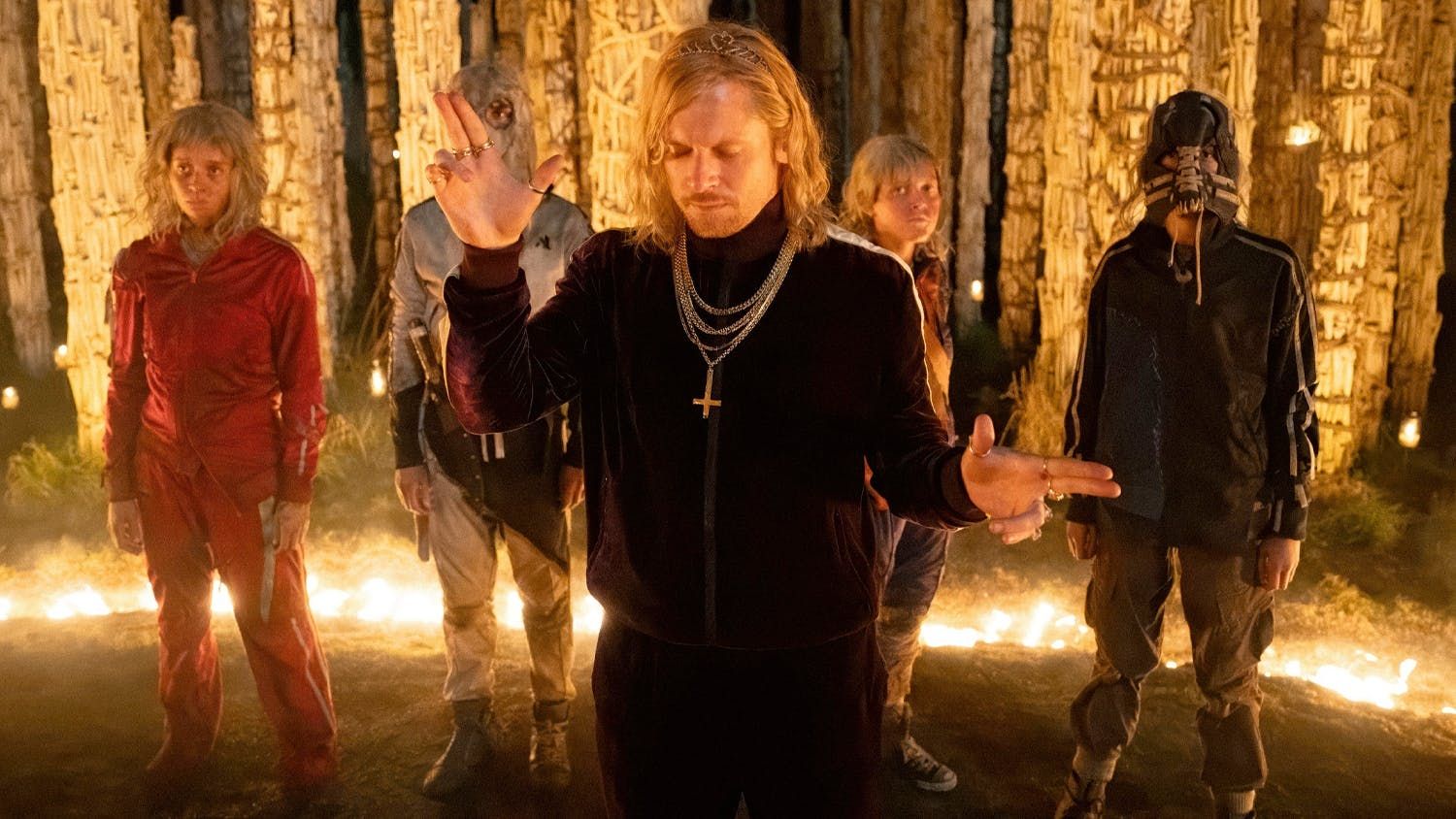
Picking up immediately following the shocking and unexpected finale of 28 Years Later, Spike (Alfie Williams) has been taken in by a gang of brightly dressed weirdos led by Sir Lord Jimmy Crystal (Jack O’Connell, Sinners), the adult version of the child we saw in 28 Years Later’s opening. Jimmy is an unhinged leader focused on cleansing through sacrifice and charity, but mostly just killing, dismembering, and flaying. Meanwhile, Dr. Ian Kelson (Ralph Fiennes, The Grand Budapest Hotel), reinvigorated by his encounter with Spike, has taken steps to try to reach the infected through a series of interactions with Samson (Chi Lewis-Parry, Gladiator II), an infected alpha who has an interest in Kelson’s Bone Temple ossuary. As Spike and Kelson go on their own personal journeys, they seemed destined to collide once again.
I can see why viewers expected a more action-heavy follow up to 28 Weeks Later, but 28 Years Later excelled because it was a more matured and confident Danny Boyle and Alex Garland examining the world they created back in 2002. It was violent, still, but more dialogue and character focused, and fans of the original film had two decades to decide what they wanted to see instead of asking these creatives to show us their vision. I loved 28 Years Later, and The Bone Temple is nearly as good. With two plotlines running concurrently for most of the run time, there’s plenty of powerful ideas at play and lots of graphic violence for the gorehounds, and it operates expertly like an extended coda to its predecessor, which makes sense as they were filmed back-to-back.

The Dr. Kelson story is slightly stronger here, with Ralph Fiennes furthering the incredible character work achieved in his first appearance as he continues his experimentation on Samson, trying to discover if there is anything worth saving underneath the infection. It has to be a thankless job being covered in all that makeup, working in the blistering sunlight and chilly nights with very little clothing, and be essentially carrying on a one man dance party for much of the run time, but the humility that Garland’s script imbues upon Kelson adds so many layers to an already strong performance. Fiennes can carry an entire movie on his own without any problem, so it’s no surprise that he has crafted some truly incredible moments, including an Iron Maiden needle drop that’s unlike anything I expected. Nia DaCosta captures these humane moments in the apocalypse with a generous helping of style while still adhering to Boyle’s visual aesthetic, but I love the life she gives to these interactions with Samson.
Chi Lewis-Parry is perhaps the biggest surprise this time around. His work in 28 Years Later was good for what was asked of the character, but he gives a largely physical performance of pathos and growth as an infected pile of meat shuffling around with flitting moments of humanity. Lewis-Parry has way more to do here, and he gives a performance worthy of comparison with Day of the Dead’s Bub.

I’m happy that Spike was still given plenty to do this time around, as I feel like this film officially positions the 28 Years Later trilogy as his story, and his time with the Jimmy gang is a completely different horror tale, one that tests him in ways he could never have expected in the previous film, where his biggest problem was the infected. Now, he’s firmly entrenched in the human aspect of a devolving society, with the extremely menacing and very unusual Sir Lord Jimmy Crystal. It would be easy to compare Jack O’Connell’s performance to his character in Sinners, but I’d argue the reprehensible nature of his Sir Lord Jimmy is at a new level of disturbing, with his cult of members all providing far more horrifying ends to their victims than being killed by the infected. Spike takes a bit of a backseat in the narrative until the third act, but his character evolution continues quite nicely here, as he’s forced to decide what kind of person he’s going to be in this new world. There’s a tragic perversion in the fact that Jimmy Crystal lost his childhood to the infected and now inflicts that same pain upon Spike.
Beyond the notable music choices, the score by Hildur Gudnadottir is terrific, matching the energy of the Young Fathers’ score for 28 Years Later and effectively using a few musical motifs from Boyle’s original film as well. She has a skill for mixing the tension with the emotional, and she fits perfectly in this world. With 28 Years Later, Alex Garland’s script was able to create these profoundly human moments within the radically horrific landscape of the apocalypse, and Gudnadottir juggles all of that in this sequel which accomplishes the same feat in completely new ways.
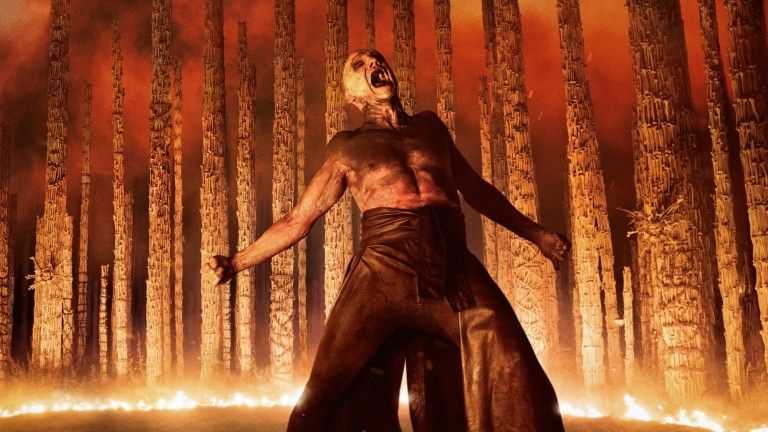
I feel like this film was tailor-made for the type of horror fan I am. I could honestly watch timelapse videos of the Bone Temple all day, but this movie taps into the same energy of its predecessor while carving new paths in the story that make me all the more excited to see the closing chapter of this trilogy. I can’t believe a movie like this could be made in the studio system, featuring a character like Samson credited with the main cast and a performance like the one given by Ralph Fiennes, which should be up for awards consideration once again. Quite simply, I loved The Bone Temple, and it’ll be a high point tough to beat in 2026.
4.5/5
-Kyle A. Goethe
Franchise reviews: 28 Days Later, 28 Years Later.
![[Early Review] The Super Mario Galaxy Movie (2026)](https://goatfilmreviews.com/wp-content/uploads/2026/04/images2828296158163771698169022.jpg?w=398)
![[Early Review] Ready or Not 2: Here I Come (2026)](https://goatfilmreviews.com/wp-content/uploads/2026/03/ready-or-not-2357191300360952847.jpg?w=686)
![[Early Review] Reminders of Him (2026)](https://goatfilmreviews.com/wp-content/uploads/2026/03/images2827293970021178971959931.jpg?w=446)
![[early review] undertone (2026)](https://goatfilmreviews.com/wp-content/uploads/2026/03/teaser-poster-undertone-scaled2177937702752989738.jpg?w=1024)
 goatfilmreviews.com
Leave a comment