
Director: Freddie Francis
Cast: Peter Cushing, Christopher Lee, Max Adrian, Ann Bell, Peter Madden, Donald Sutherland, Roy Castle
Screenplay: Milton Subotsky
98 mins. Approved.
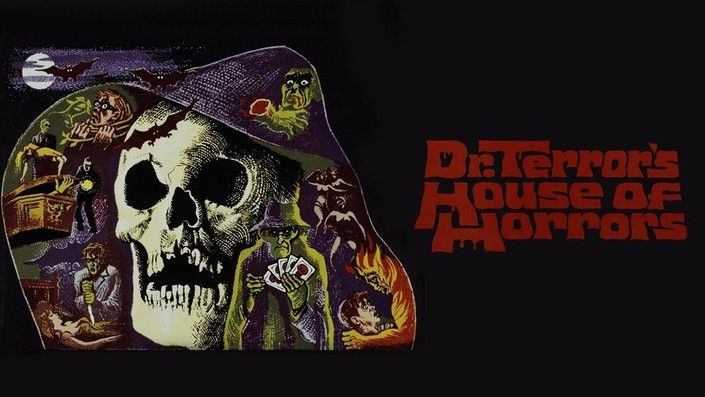
When I was around five years old, I discovered two books at my local library on the subject of horror movies. By this time, I had seen Halloween, one of my mother’s favorite horror films, along with several other genre classics, but these two books, both heavily illustrated coffee-table sized books, went with me everywhere. I repeatedly renewed the rentals, and I was always paging through it. The reason I bring that up today is related to the cover of one of the books, which featured a skeletal creature in a hood, mouth agape, looking through the page at me, and now, having watched Dr. Terror’s House of Horrors, I’ve recognized that skeletal face in the final moments of the film. As far as anthologies go, Dr. Schreck (Peter Cushing, Star Wars) and his tarot deck are more than worthy of horror movie book cover status.

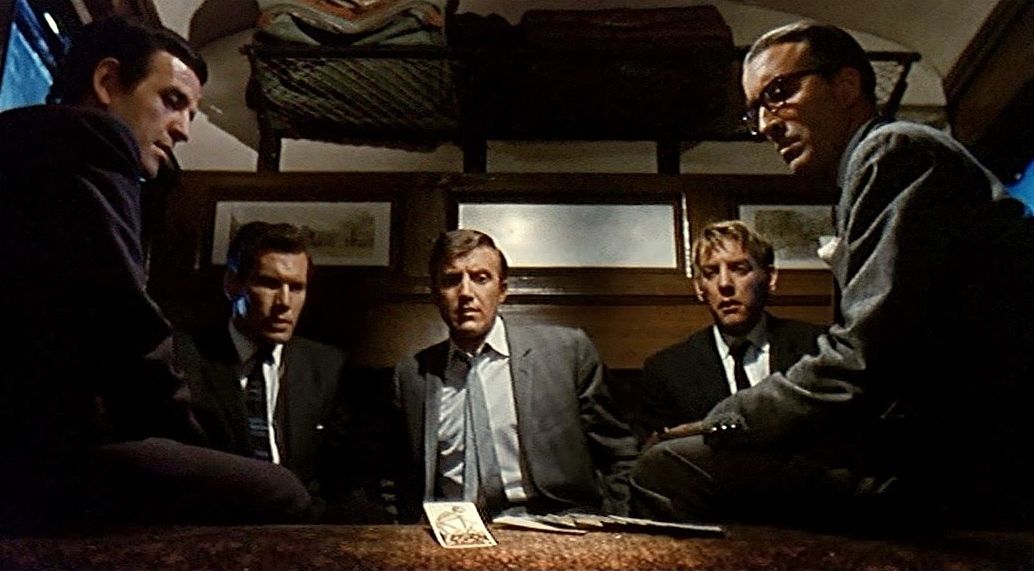
Five random strangers find themselves aboard in the same train car on their way to the town of Bradley. They are joined by a sixth man, Dr. Schreck, which is German for “terror.” He informs the men of his tarot deck, which can predict their futures. As he draws each man’s fortune, it becomes clear that they are all destined for danger.
The wraparound segment for this Amicus anthology is one of the best, allowing for us to get to know the five leads of the five stories, but also giving a delicious Peter Cushing performance and nailing down the rules and guidelines of the five stories as well with its tarot card framework. Anthologies tend to overthink or underthink the wraparound, but simplicity works well for Dr. Terror.
The first story, titled “Werewolf,” follows Jim Dawson, an architect who is working to restore an old family home when he finds a fake wall holding the coffin of Count Cosmo Valdemar, the original owner of the home and a reported werewolf. Dawson believes that the Count has returned in the dark of night to feed on the staff. Werewolf has some nice gothic set design and old crypts, even if it has a bit too abrupt of a finale, and Neil McCallum, who plays Dawson, does a serviceable job.
The second story, titled “Creeping Vine,” seems to be the one most viewers loathe, but I quite enjoyed it. Alan Freeman plays Bill Rogers, a family man who discovered a deadly vine gathering around his home. The vine is possibly intelligent and very hungry. While Freeman, who was not an actor but a DJ, is not great in the lead role, the actual silly scares of the killer plant worked pretty well for me, but I’m also a defender of “The Lonesome Death of Jordy Verrill” in Creepshow, so maybe I just like killer plant stuff.

The third story is called “Voodoo,” and it has a nice change of pace, following Biff Bailey (Roy Castle, Carry on Up the Khyber), a jazz musician who steals the sacred tune of the god Dambala for his act while playing music in the West Indies. This one feels tonally in line with the rest of the segments while introducing a different visual flavor with its more tropical setting and mixture of voodoo and music.
The fourth story, a fan favorite and rightfully so entitled “The Disembodied Hand,” is the most deliciously wicked, following Franklyn Marsh (Christopher Lee, The Lord of the Rings: The Fellowship of the Ring), an art critic who doesn’t like it when he’s played for a fool, killing a man who mocked him and losing a hand in the process, only to discover his hand returning to haunt him. It’s a classic type of setup for an anthology of the time period, and Lee makes the most of it, playing a villainous character who deserves everything he gets.
The final story, “Vampire,” gets going with Donald Sutherland (The Hunger Games) as Dr. Carroll, who begins to suspect that someone very close to him is a vampire feeding on the blood of his patients. This one has an interesting take on vampire mythology, and it has an interesting twist, though I didn’t like the tonal shift when a character directly addresses the audience at the end for a zinger, but everything up to that is good with solid early work from Sutherland.
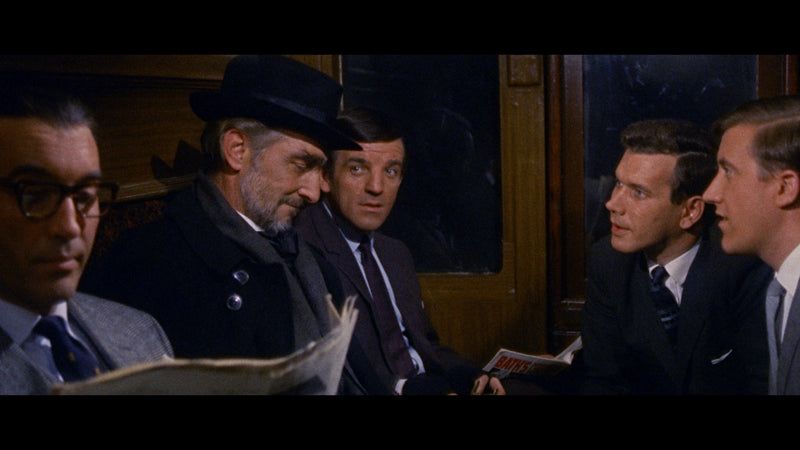
Dr. Terror’s House of Horror has a pretty evenly toned collection of stories that fit nicely together, and I don’t personally think there is a single bad story in the bunch, a difficult feat to achieve. Even more commendable is the simple but effective framing device with Peter Cushing, who gives a performance with so much presence that I kind of forgot that he never actually appears in any of the stories themselves outside of his wraparound. This house of horrors is well worth your spooky rotation, as its one of the better horror anthologies I’ve seen.
3.5/5
-Kyle A. Goethe
- For my review of Freddie Francis’s Paranoiac, click here.
![[Early Review] Hoppers (2026)](https://goatfilmreviews.com/wp-content/uploads/2026/03/2rrluifizgwwih8iaeo6o0iyhmx3787975694325498065.jpg?w=780)
![[Early Review] Dreams (2025)](https://goatfilmreviews.com/wp-content/uploads/2026/02/mv5bognjnwy2njitzmviny00mzuylwjlztgtnwixm2zkyzrln2iwxkeyxkfqcgc40898657501061265853.jpg?w=1024)
![[Early Review] How to Make a Killing (2026)](https://goatfilmreviews.com/wp-content/uploads/2026/02/how-to-make-a-killing-2026-glen-powells-latest-v0-2i0jsftyz9kg15544568086016026709.jpeg?w=640)
![[Early Review] EPiC: Elvis Presley in Concert (2025)](https://goatfilmreviews.com/wp-content/uploads/2026/02/maxresdefault285298211723424943325763.jpg?w=1024)
 goatfilmreviews.com
Leave a comment