

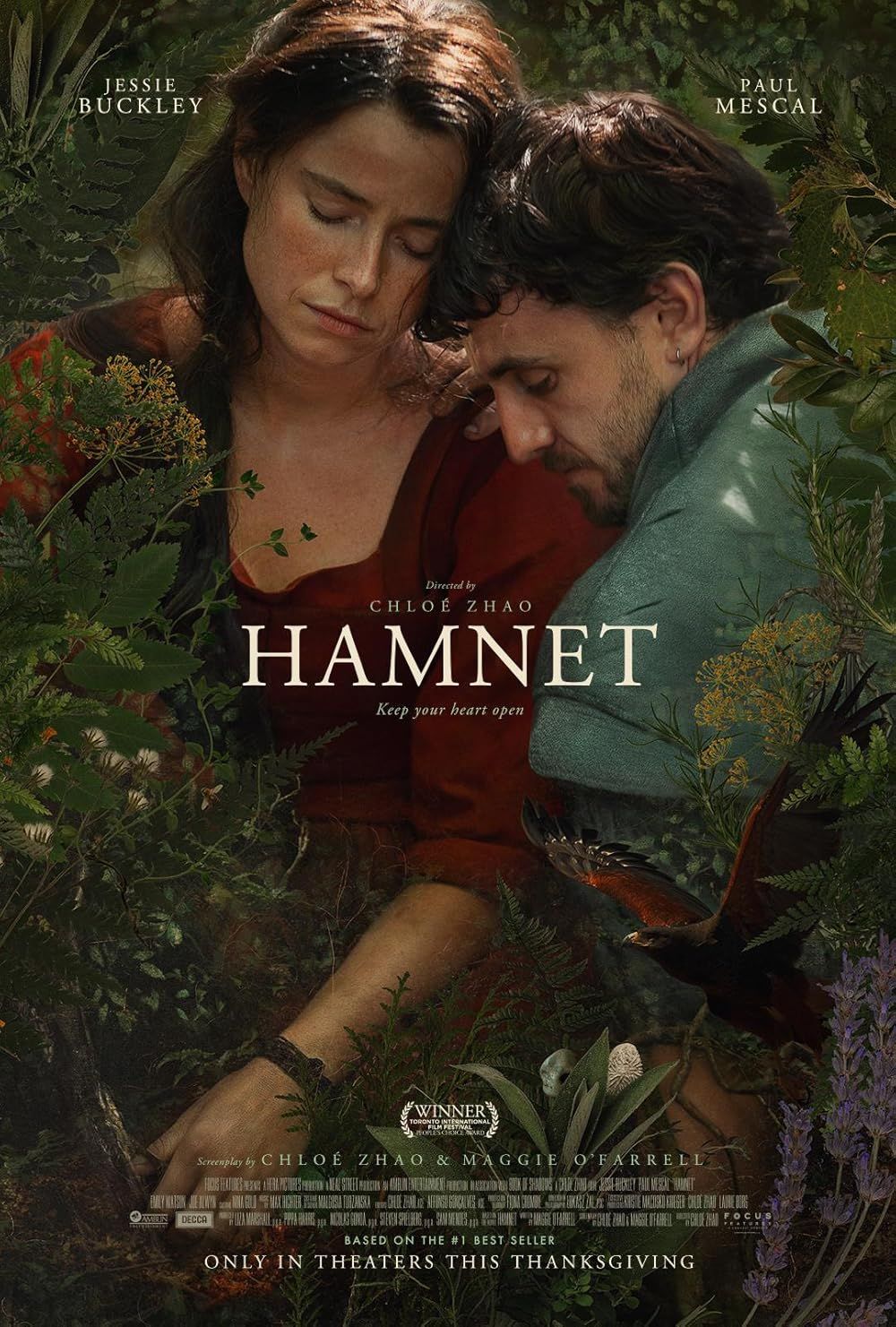
Director: Chloe Zhao
Cast: Jessie Buckley, Paul Mescal, Emily Watson, Joe Alwyn
Screenplay: Chloe Zhao, Maggie O’Farrell
125 mins. Rated PG-13 for thematic content, some strong sexuality, and partial nudity.
Movies based on the works of William Shakespeare are frequent in and out of Hollywood, but movies actually about Shakespeare don’t occur nearly as often, and they rarely work. Within that framework, Hamnet is probably the best film that features the man known as Shakespeare, and that’s probably because it isn’t completely his story.
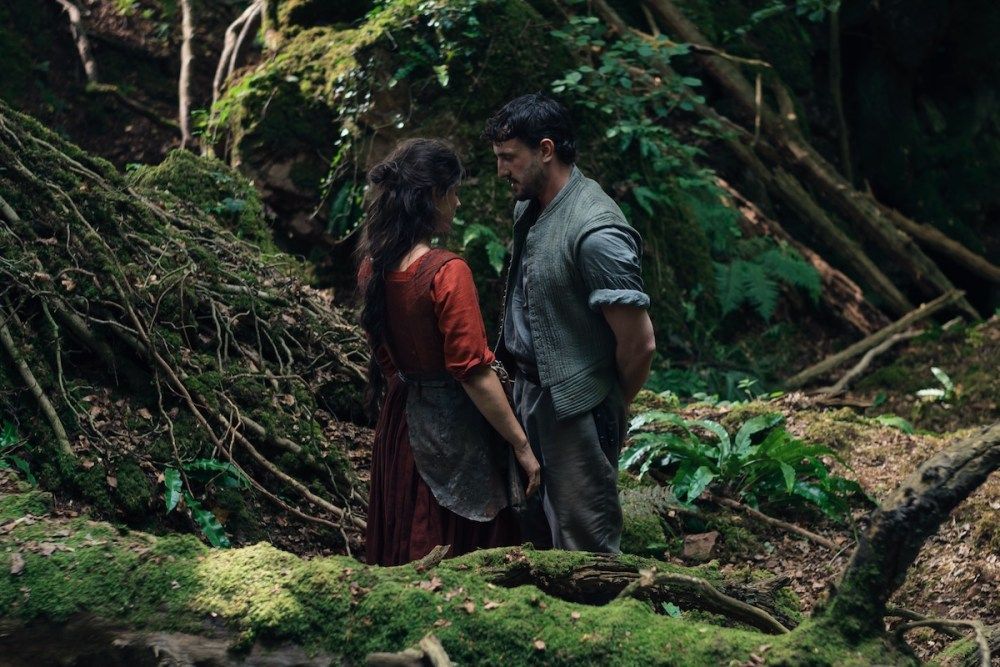
Hamnet is the story of two lovers, Agnes (Jessie Buckley, Men) and husband/playwright William (Paul Mescal, Aftersun), and the family they share. Beginning at the start of their love affair, their children, and the eventual tragedy would tear them asunder, as well as the creation of Shakespeare’s most celebrated work, Hamlet.
The story of Agnes and William is quite universal, but the details are what makes Hamnet a special film. Agnes, often seen as bewitched and sinful, is frequently in nature, while William, the wordsmith, is often reading, writing, and developing his brain. The two couldn’t be more different, and these differences are what bring them together, as well as pulling them apart as they deal with the film’s central tragedy. Seen in three acts, Hamnet is about the forging of this relationship, the pain of the loss, and the reforming of these two peoples through the power of art, words, and creation.
Jessie Buckley is an actor who has only been more impressive the more she appears, and most of Hamnet belongs to her, as William is off writing, working, and trying to make a name for herself. This is Agnes’s story all the way through, and her performance evolves through each of the major acts of the film, from her wild and fired-up youth to her loving and caring matriarch of the family into the tragic turn and the search for healing. She’s aided by Mescal’s William but make no mistake: Hamnet works because of Jessie Buckley. There’s a scene where she chastises William for not being there when his family needed him, not being there to bid his child farewell, and it’s the hardest hitting moment in their relationship.
The pacing of the narrative takes a bit to get going, but once it does, there’s a comfortable evolution as the story plays out. While I didn’t find the first half of Hamnet to have impact, once Agnes and William are reckoning the loss of a child, this movie really taps into universal fear and pain, and the crescendo of the finale, set in the Globe theater, is magnificent, outside of an unusual song choice that plays in the final scene. I’m a big fan of Max Richter’s On the Nature of Daylight, but the inclusion of this piece of music in the final moments of the film took me out of the narrative a bit, as my mind started wandering through the iconic and oft-used music that shows up too often elsewhere. The overuse of the song doesn’t lessen its impact, but it did pull me out of the emotion for a moment. Still, though, seeing how William funneled his pain and anger into his work is devastating and graceful and still sits with me after leaving the theater.

Hamnet needs a bit of forward momentum in that first half, but when the story is working, it’s excellent and emotional and overwhelming. This is Jessie Buckley’s time to shine as Agnes, and so much of the film rests on her performance, oftentimes without the dialogue to aid in that journey. She excels at the quiet moments, and the film is all the better for it. It’s certainly the best film from director Chloe Zhao (Eternals), and it’s worth seeing for a good dose of dramatic healing in the face of desolation.
4/5
-Kyle A. Goethe
![[Early Review] Hoppers (2026)](https://goatfilmreviews.com/wp-content/uploads/2026/03/2rrluifizgwwih8iaeo6o0iyhmx3787975694325498065.jpg?w=780)
![[Early Review] Dreams (2025)](https://goatfilmreviews.com/wp-content/uploads/2026/02/mv5bognjnwy2njitzmviny00mzuylwjlztgtnwixm2zkyzrln2iwxkeyxkfqcgc40898657501061265853.jpg?w=1024)
 goatfilmreviews.com
Leave a comment