

A few short reviews of MSPIFF films:

Quisling: The Final Days (2024)
Following the ending of the German occupation of Norway in 1945, Minister President Vidkun Quisling is taken into custody for high treason as a Nazi collaborator. While he understands the situation he’s in, he insists he’s done nothing wrong, nothing illegal, and he was in fact doing the work necessary to keep his country and people safe. As the world closes in all around him, his only solace is in the form of hospital chaplin Peder Olsen, a man assigned to Quisling’s pastoral care. Peder has his own uncertainties about Quisling, and the two of them have to traverse the accountability and damaged faith within their lives.
Quisling is a strong acting showcase for Gard B. Eidsvold (Troll) as the former leader, and the scenes shared with Anders Danielsen Lie (The Worst Person in the World) as Olsen are electrifying. Director Erik Poppe puts us in the room with these two men and asks us to understand this man, this monster, much in the same way we have a fascination with murder podcasts. Quisling’s journey in the film is coming to terms with the fact that he is not the hero. When he claims to have helped more Jews than anyone in Norway, his monologue came across so absurd, even considering the heinous crimes involved. It’s a pretty good 2 1/2 hour movie that would’ve been a truly great 2 hour movie, as Poppe wants to cover so much territory that it feels stuffed, when the focus should have been more limited to these two men and their mutual crisis of faith. Quisling and Peder keep coming back to this parable of Jesus and the sinful woman who washes his feet. It’s a powerful part of the bible that doesn’t come up often, but its placement in the narrative is excellent and thought-provoking.
3.5/5
-Kyle A. Goethe

The Swedish Torpedo (2024)
We’ve seen a number of captivating recent films about swimmers, from Nyad to Young Woman and the Sea, but The Swedish Torpedo is not one of them. With the impending danger of World War II on the horizon, Sally Bauer (Josefin Neldén, Border) may just miss her window to swim the English Channel, and she won’t let that opportunity pass her by. Dedicating everything in her power to the incredible feat, she finds that she is failing those around her who need her, and she needs to weight the importance of this personal accomplishment with the possibility of losing everything else.
There isn’t anything flat-out bad in The Swedish Torpedo. It’s just that it isn’t inherently exciting and it doesn’t have much for staying power. There are simply better films that tackle this personal toll, and The Swedish Torpedo doesn’t stand out. The swimming portions aren’t captured in a particularly captivating way, and the scenes of Sally trying to organize and juggle the responsibilities of her life make her come across as neither likable nor interesting. I kept wanting to like The Swedish Torpedo more than I did. It’s fine, but it could’ve been so much more.
2.5/5
-Kyle A. Goethe
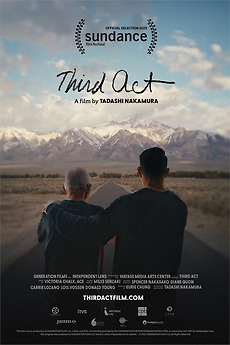
Third Act (2025)
This documentary, from director Tadashi Nakamura, chronicles the life of his father, the activist and artist Robert A. Nakamura, and his recent diagnosis of Parkinson’s. He weaves through the complicated relationship they shared, as well as their bonding over the power of art and the movies, and also how they approach grief, both shared and passed down. In the case of Robert, much of this pain and grief comes from his incarceration in an American concentration camp in WWII. Though Tadashi didn’t physically experience this pain, it’s still very much a part of his life.
Only vaguely aware of the work of Robert A. Nakamura, Third Life is at the very least a collection of great recommendations, but it’s often much more than just that. Tadashi’s great at asking questions that don’t always have answers, or they have painful answers, but he also imbues the documentary with so much love that the finished film is neither dour nor flowery for too long at once. You can see the passion that Tadashi has for finishing this film before his father’s condition progresses past the point to be helpful, but I appreciate that even he questions this need as their limited time together grows short. It’s a moving portrait of two generations that occasionally slips into home movie territory, but it’s also necessary for fans of its subject.
3/5
-Kyle A. Goethe

When Fall Is Coming (2024)
A complex narrative of multiple characters and unpredictable narrative choices, When Fall Is Coming follows Michele (Hélène Vincent, Three Colours: Blue), a retired woman living in a peaceful little village near her dear friend Marie-Claude (Josiane Balasko, The Tenant). When Michele’s grandson is meant to stay with her during school vacation, a mistake during mushroom picking sets in motion a series of drastic adjustments to Michele’s life, affecting everyone she knows and radically rewriting her story in the process.
This drama has a lot going on, and its biggest strength is that it is simply and completely unpredictable in every way. The narrative is constantly making big moves, reframing the narrative for the next part of the story. It’s a little all-over-the-place and occasionally feels bloated with ideas, it also never feels boring or like its underserving Michele and her journey. There were some aspects that I would’ve liked expounded upon (like Michele’s former profession and how it impacted her life’s direction), the mark of a good movie is wanting to spend more time in its world, and this film accomplishes that quite well.
3.5/5
-Kyle A. Goethe

Souleymane’s Story (2024)
A story that is becoming more and more universal in recent years, Souleymane’s Story unfolds over 48 hours on the busy streets of Paris a back-and-forth odyssey of navigating problems as an immigrant. Souleymane pedals through the city as a delivery man, dealing with the difficulties associated with his asylum application interview, but as his problems begin to gather speed, they threaten to steamroll any chances of him finding safe haven in Paris.
With a strong central performance from newcomer Abou Sangare as the titular Souleymane, this movie lives off the realism of his portrayal with the help of director/co-writer Boris Lojkine (Camille) slowly taking away the character’s options as more and more problems present themselves on this wildly stressful 48 hours. With shades of the Safdie Brothers and their film Good Time (though with a much more likable focal character), Souleymane’s Story bleeds with stress and tension. Now, I didn’t find the climactic interview sequence to have the intended impact, but that shouldn’t take away from the strengths of the rest of the film, and the palpable fear that I felt for Souleymane as his choices dwindled all around him.
3.5/5
-Kyle A. Goethe
![[Early Review] Ready or Not 2: Here I Come (2026)](https://goatfilmreviews.com/wp-content/uploads/2026/03/ready-or-not-2357191300360952847.jpg?w=686)
![[Early Review] Reminders of Him (2026)](https://goatfilmreviews.com/wp-content/uploads/2026/03/images2827293970021178971959931.jpg?w=446)
![[early review] undertone (2026)](https://goatfilmreviews.com/wp-content/uploads/2026/03/teaser-poster-undertone-scaled2177937702752989738.jpg?w=1024)
![[Early Review] Project Hail Mary (2026)](https://goatfilmreviews.com/wp-content/uploads/2026/03/project-hail-mary-movie5671626905221961855.jpg?w=960)
 goatfilmreviews.com
Leave a comment